
[interactive_buttons]
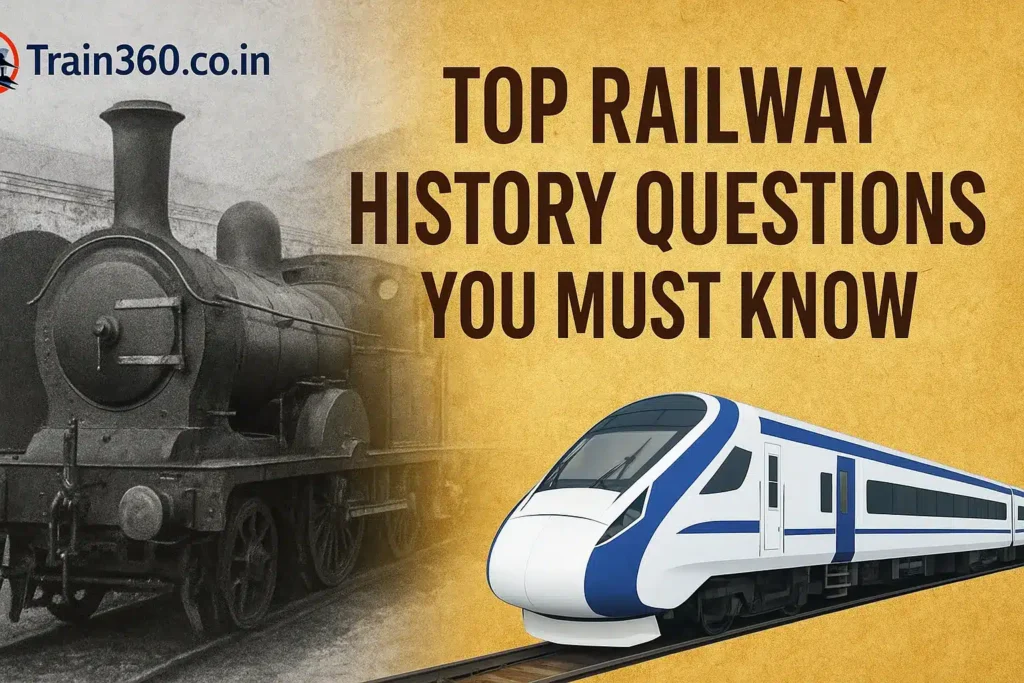
Top Railway History Questions You Must Know, From India’s First Train to Modern High-Speed Rails
The history of railways is not just about trains; it’s a story of progress, innovation, and connection. Whether you’re getting ready for competitive exams like RRB, Group D, or NTPC, or you just enjoy learning about the evolution of Indian Railways, knowing key railway history questions is essential. In this article, we explore the most interesting facts, milestones, and frequently asked questions about the history of Indian and world railways.
Introduction to Railway History
The journey of railways began in the early 19th century when steam engines changed transportation forever. In India, this journey started on April 16, 1853, when the first passenger train ran between Bombay (Mumbai) and Thane, covering 34 km. This event laid the groundwork for one of the world’s largest railway networks.
Today, Indian Railways is the fourth largest railway network in the world, serving millions daily. To learn more about India’s rich train heritage, you can also read our detailed article on the Kalka Shimla Railway History, a UNESCO World Heritage marvel.
Top Railway History Questions and Answers
1. When did the first train run in India?
The first train in India ran on 16th April 1853 between Bombay and Thane. It was pulled by three steam locomotives named Sahib, Sindh, and Sultan.
2. Who is known as the Father of Indian Railways?
Lord Dalhousie is known as the Father of Indian Railways for his vision of connecting different regions with rail lines for better administration and trade.
3. Which is the oldest running train in India?
The Kolkata–Delhi Mail (previously called the Calcutta–Delhi Mail) is considered one of the oldest continuously running trains in India.
4. When was Indian Railways nationalized?
Indian Railways was nationalized on January 1, 1951, bringing all private railway companies into a single system managed by the government of India.
5. Which is the longest train route in India?
The Vivek Express (Dibrugarh to Kanyakumari) covers around 4,273 km, making it the longest train route in India.
6. When did the first electric train run in India?
The first electric train ran between Bombay Victoria Terminus (now CST) and Kurla on 3rd February 1925.
7. Which is India’s fastest train?
Vande Bharat Express currently holds the title of India’s fastest train, reaching speeds of up to 180 km/h and representing India’s technological growth.
8. What is the importance of the Kalka-Shimla Railway?
The Kalka-Shimla Railway is a historic narrow-gauge line built in 1903. It showcases British engineering and connects the Himalayan foothills with Shimla, which was once the summer capital of British India.
9. Which is the world’s first railway?
The world’s first railway opened in 1825 between Stockton and Darlington in England, designed by George Stephenson.
10. Which is the largest railway station in India?
Howrah Junction in Kolkata is India’s largest railway station with 23 platforms and one of the busiest stations in Asia.
Fun Railway History Facts
- The Indian Railways has its own postal code: 110001.
- It employs over 1.3 million people, making it one of the world’s largest employers.
- The Darjeeling Himalayan Railway was declared a UNESCO World Heritage Site in 1999.
- India’s first bullet train project is between Ahmedabad and Mumbai, inspired by Japan’s Shinkansen technology.
Global Railway History Highlights
Railways played a key role in the Industrial Revolution. The first public steam railway, the Stockton and Darlington Railway, marked the start of mass transportation in the 19th century. Later, countries like Japan, Germany, and France took the lead in high-speed rail technologies such as the Shinkansen and TGV.
Learn more about the world’s railway history through Wikipedia’s History of Rail Transport.
Why Railway History Questions Matter
Understanding railway history isn’t just for exam prep; it helps us appreciate how railways shaped trade, travel, and national unity. For students, enthusiasts, and travelers, these facts provide insights into how innovation and engineering have evolved over the years.
Related Topics on train360.co.in/
Conclusion
The story of railways blends human creativity, determination, and vision. From the first steam engines to today’s bullet trains, each milestone shows how far we’ve come. Whether you’re a rail fan or getting ready for a government exam, mastering these railway history questions will not only help you score better but also deepen your respect for this incredible network that connects India and the world.


Pingback: Vande Bharat Train List 2025: Routes, Timetable & New Launches - Train360°