
[interactive_buttons]
Indian Railways new fare hike 2025: Comparing AC & Sleeper Ticket Prices
Starting July 1, 2025, Indian Railways has made some noticeable changes to passenger fares. If you’re someone who travels by train often, this seemingly “small” fare hike could actually have a significant impact on your monthly expenses, especially if you tend to choose AC or long-distance Sleeper class. This guide will break down what’s changed, how much more you’ll be paying, and whether opting for AC is still worth it compared to Sleeper class in 2025.
What’s the Indian Railways new fare hike 2025 ?
In June 2025, the Ministry of Railways released an official statement announcing a revision of basic passenger fares, applicable for tickets bought on or after July 1, 2025.
Here are the main points of the new fare structure:
- No changes to suburban train fares or monthly season passes.
- Small increases in non-AC ordinary and Mail/Express classes, measured in paise per kilometer.
- Moderate increases in AC classes, particularly on Mail/Express and premium trains.
- No changes to reservation fees, superfast surcharges, or GST.
While these changes might seem a bit technical, when you calculate the per-kilometer increase over longer distances like 800 km or 1,500 km, the extra costs add up—especially for families and frequent travelers.
How much extra will you be paying? (Simple breakdown)
To make it easier to understand, here’s the official change presented in a traveler-friendly manner:
1. Ordinary non-AC passenger trains
- Second Class: An increase of 0.5 paisa per kilometer, with no increase for journeys up to 500 km.
- Sleeper & First Class (where available): Also an increase of 0.5 paisa per kilometer.
This means if you take a 1,000 km journey in an ordinary second-class coach, your fare will go up by about ₹5. The increase for Sleeper in the same segment is similar since it’s also distance-based.
2. Mail/Express non-AC trains (including most long-distance options)
- Second Class: +1 paisa per kilometer.
- Sleeper Class: +1 paisa per kilometer.
- First Class: +1 paisa per kilometer.
For a typical 1,300 km journey in a Mail/Express Sleeper, you’ll now be paying roughly ₹13 more on the base fare. While that might seem small on its own, if you add family members or take multiple trips each year, it really adds up.
3. AC classes on Mail/Express and premium trains
- AC Chair Car (CC)
- AC 3-Tier & 3E (Third AC Economy)
- AC 2-Tier
- AC First / Executive Chair Car / Executive Anubhuti
All these AC classes now have a fare rise of 2 paise per kilometer on the base rate. For a 1,000 km journey:
- AC 3-Tier tickets will cost about ₹20 more.
- AC 2-Tier tickets will also see an increase of around ₹20 for 1,000 km.
- AC First or Executive classes experience a similar distance-based increase, but since the base fare is already high, the overall cost still feels like a premium option.
Premium trains like Rajdhani, Shatabdi, Duronto, Vande Bharat, Tejas, Humsafar, Gatimaan, and Jan Shatabdi will follow this new fare structure. So if you prefer quick and comfy trains, be ready to pay a bit more for that speed and luxury.
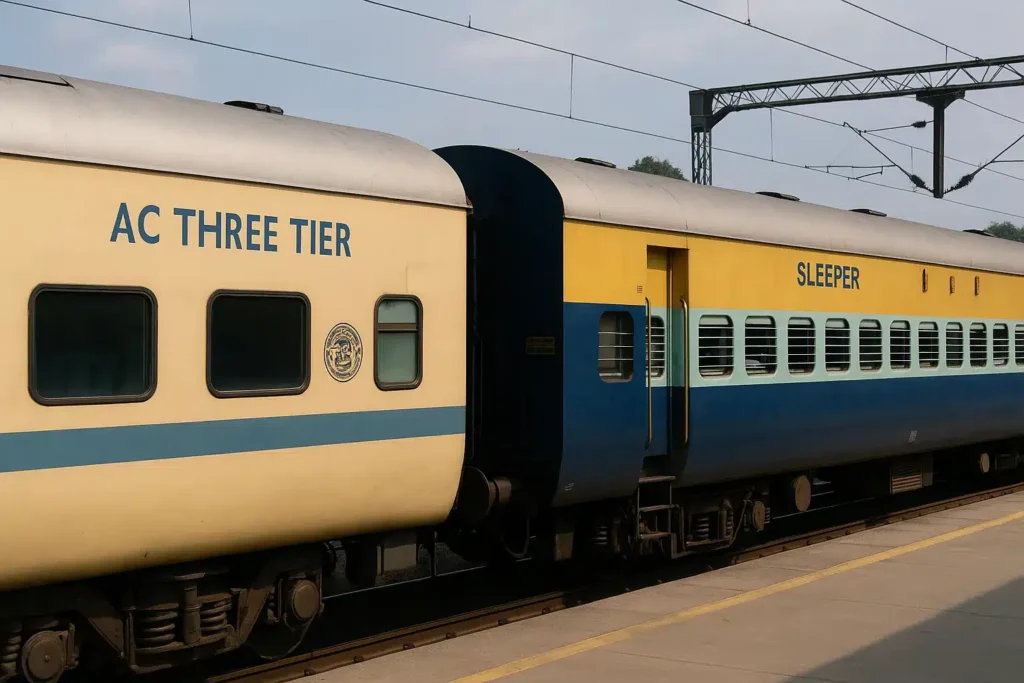
AC vs Sleeper after the 2025 fare increase: Which one gets you more bang for your buck?
Let’s look at a comparison between AC and Sleeper in a straightforward manner. Picture yourself taking a popular long route like Delhi–Mumbai or Patna–Bengaluru on a Mail/Express train.
| Class | Approx. Old Base Fare (1,300 km) | Approx. Increase (2025) | Approx. New Base Fare |
|---|---|---|---|
| Second Sitting (2S) | ₹450 | +₹13 | ₹463 |
| Sleeper (SL) | ₹750 | +₹13 | ₹763 |
| AC 3-Tier (3A) | ₹1,950 | +₹26 | ₹1,976 |
| AC 2-Tier (2A) | ₹2,850 | +₹26 | ₹2,876 |
| AC First (1A) | ₹4,800 | +₹26 | ₹4,826 |
These numbers are rough estimates to illustrate the impact, not precise IRCTC fares. The trend is clear: Sleeper tickets remain considerably cheaper overall, while AC fares have a somewhat larger increase in absolute terms because they are distance-based plus other surcharges.
So, should you still opt for AC?
Well, it really comes down to what you value:
- Go for Sleeper if you’re traveling with a family or group and are on a tight budget, or if you don’t mind basic comfort and sharing space.
- Choose AC 3-Tier if you want a decent mix of comfort, security, and price—especially for those longer overnight journeys lasting 10–12 hours.
- Opt for AC 2-Tier or 1A only if you highly prioritize privacy, quietness, and better sleep; or if your ticket is funded by your office, a client, or travel allowances.
Who will feel the impact of the 2025 fare increase the most?
Even though this increase is described as “modest,” some groups of travelers will definitely feel it more than others. Here are three types that are likely to notice the changes:
1. Travelers using Sleeper class for long distances
Students, migrant workers, and middle-class families who rely on Sleeper class for trips ranging from 1,000 to 2,000 km will notice a rise, especially when booking multiple berths. A family of four taking two long trips a year could end up spending a few hundred rupees more overall.
2. Regular AC passengers
For those who typically travel in AC 2-Tier or AC 3-Tier, the increase per kilometer along with GST and dynamic pricing could make tickets feel pricier during peak times. However, many AC passengers accept this as part of the trade-off for comfort, reliable temperatures, and better security.
3. Budget-conscious solo travelers
Backpackers or solo workers moving between cities might think twice about choosing AC over Sleeper. For overnight trips, many are opting for Sleeper plus a few personal comforts like their own blankets, pillows, and earplugs to enhance their experience without paying for AC-level fares.
Smart tips to save money despite the fare increase
Even with these new prices, there are some handy tricks to help manage your travel budget:
- Book as early as possible: Try to secure your tickets as soon as the booking window opens to dodge last-minute fare spikes.
- Utilize automated tools for Tatkal bookings: If you need a Tatkal ticket, speed is key. Consider tools like the IRCTC Tatkal automation helper on our platform to fill in details quickly and boost your chances of getting a ticket.
- Travel during off-peak times: Steer clear of busy holiday seasons and long weekends when trains are packed and alternative options are costly.
- Mix different classes: For longer journeys, some travelers opt to take a Sleeper for part of the trip and then upgrade to AC for the most exhausting leg, given that options allow for it.
- Watch your food expenses: The cost of food, snacks, and tea onboard can creep up. Check out the updated Railway food price list 2025–26 before you travel to know what the official prices are and avoid being overcharged.
Why did Railways decide to raise fares now?
Indian Railways is undergoing a major modernization effort—upgrading tracks, introducing high-speed and semi-high-speed trains, redeveloping stations, boosting safety measures, and digitizing various operations like ticketing and signaling. All these upgrades require a lot of investment and ongoing revenue. A slight increase in fares, based on distance, is one of the ways they plan to support this transformation, while still keeping train travel accessible to everyone.
In simpler terms, Indian Railways is trying to juggle two main goals:
- To remain the most affordable long-distance travel option for millions of Indians.
- To generate enough revenue for modernization efforts, improving punctuality, and reducing accidents.
Why keep an eye on fare updates with Train360?
train360.co.in/ is designed with everyday Indian train travelers in mind—students, job seekers, families, railway enthusiasts, and budget-minded travelers. Our mission is straightforward: to keep up with reliable sources like official Railway Board announcements, PIB updates, and additional information from resources like the Indian Railways Wikipedia page, while explaining everything in plain language:
Alongside fare hike information like this, you’ll find route guides, food price breakdowns, automation assistance for quicker bookings, and a lot more resources aimed at making your journey smoother. Instead of sorting through complicated government documents and several news articles, you get one clear, easy-to-read summary.
Key Takeaways: Indian Railways Fare Increase 2025
- The fare hike is effective from July 1, 2025, for tickets booked on or after this date.
- Suburban and seasonal train fares stay the same.
- Ordinary non-AC classes will see a 0.5 paisa/km increase; Mail/Express non-AC will see a 1 paisa/km increase.
- AC classes will experience a 2 paisa/km increase in Mail/Express and premium trains.
- Sleeper continues to offer the best value, while AC provides comfort at a slightly higher price.
- Strategic planning, early booking, and better budgeting for food can help offset some of the fare increase.
Frequently Asked Questions about Indian Railways Fare Increase 2025
1. When do the new railway fares take effect?
The revised fares apply to all passenger tickets booked on or after July 1, 2025. If you reserve your ticket before that date, you won’t have to cover any difference, even if your journey is later.
2. Are there any changes to suburban and local train fares?
Nope, suburban train fares and monthly season passes remain unchanged in the 2025 revision. The fare hike primarily impacts ordinary passenger, Mail/Express, and AC classes used for medium to long-distance travel.
3. How much more will I be paying for a 1,000 km AC 3-Tier journey?
Since AC classes now cost 2 paise more per kilometer, a 1,000 km journey in AC 3-Tier will be about ₹20 higher on the base fare, excluding GST and other fixed charges.
4. Will Tatkal, reservation fees, or superfast surcharges also rise?
Not at all. The 2025 revision only affects the basic distance-based fare. Tatkal charges, reservation fees, superfast surcharges, and GST will continue according to current rules.
5. How can I manage higher fares without canceling my trips?
Plan ahead, avoid peak travel dates, choose Sleeper class whenever you can for budget travel, and limit add-on costs like food and last-minute cabs. Tools like Tatkal automation helpers and updated food pricing guides can also assist you in controlling the total expenses of your trip.